
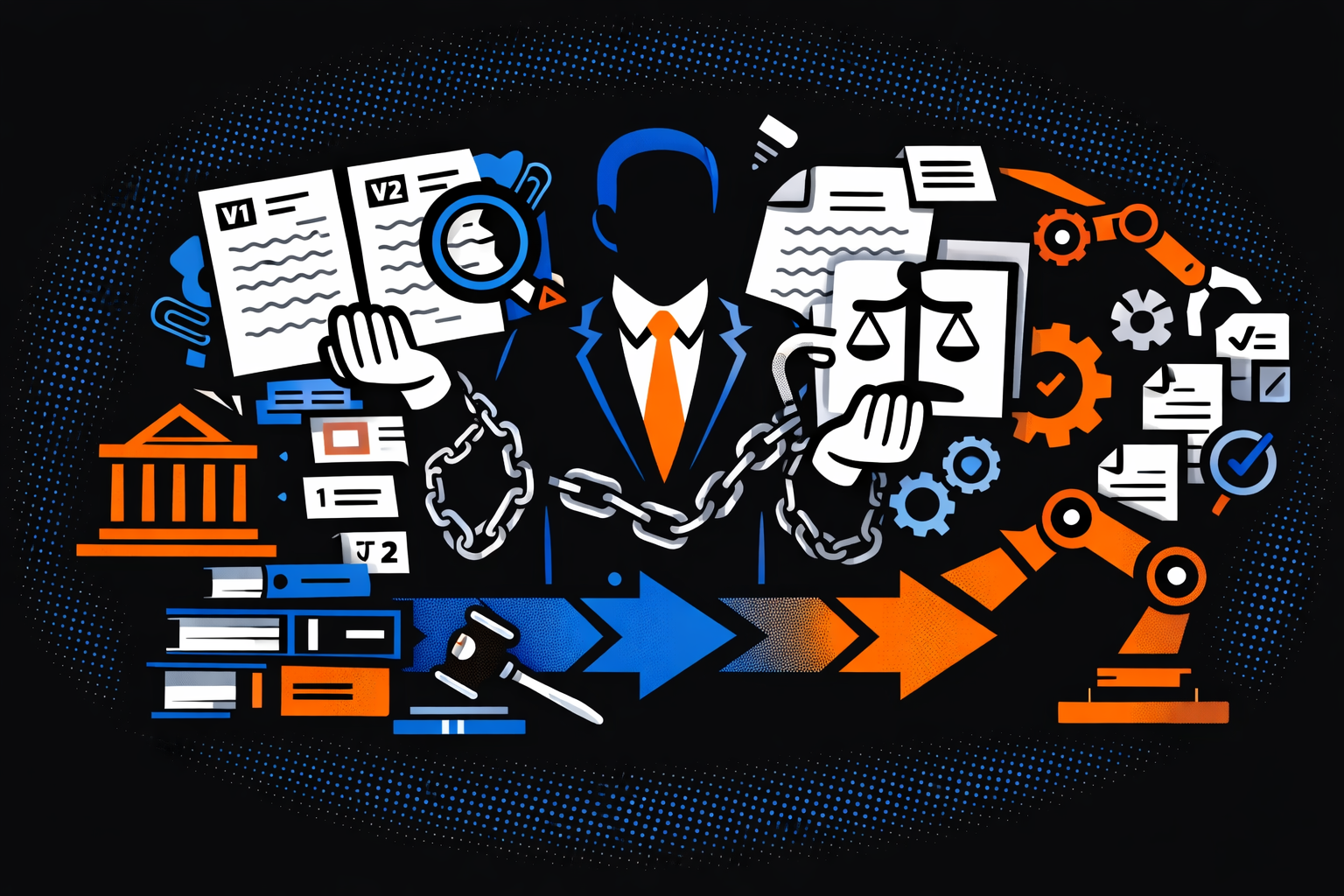
The Manual Work Trap: Why Your Legal Team Spends a Large Share of Their Time on Tasks Technology Should Handle
Your attorneys are manually comparing contract versions, copying defined terms between documents, and checking citations one by one. Across analyzed processes, cumulative manual work gaps reveal that skilled legal professionals are functioning as human copy-paste machines instead of practicing law.
Want to see if these patterns match your organization?
Let's do a 30-minute workflow walkthrough.
Does this sound familiar?
Check the patterns that match your organization. If you identify 3 or more, there's likely meaningful capacity to unlock.
Note: this is a pattern guide—not a diagnosis. The goal is recognition, then validation on one workflow.
Top priority workflows
The highest-impact processes worth examining first.
Contract Drafting
· Legal PracticeDoes this sound familiar? Manual template adaptation and term consistency checking consume meaningful time per contract.
What's really happening: Associates spend substantial hours monthly on contract drafting, with meaningful time per execution consumed by manual template customization and ensuring cross-reference consistency across defined terms and section references. Email-based coordination with clients to clarify incomplete business requirements creates significant overhead, while version control challenges during multi-reviewer cycles add further time per contract and risk attorneys working from outdated drafts.
What typically changes it: Intelligent drafting assistants can pre-populate templates with transaction-specific terms, automatically maintain defined term consistency throughout documents, and flag missing cross-references in real-time during drafting. The system handles template adaptation, term management, and version reconciliation across review cycles, while attorneys focus their expertise on risk analysis, legal strategy, and client-specific customization that requires professional judgment.
Outcome: Reducing template customization and consistency checking substantially recovers significant hours monthly of billable attorney time, while streamlining client coordination and version management accelerates contract delivery per execution.
Contract Review and Analysis
· Legal PracticeDoes this sound familiar? Manual cross-referencing and coordination consume a significant share of every contract review.
What's really happening: Attorneys spend substantial hours monthly on contract review, with a significant share consumed by manual cross-referencing between contracts and client playbooks, and another meaningful share lost to email coordination clarifying client priorities. Each review requires repeated document switching, manual extraction of key terms into summary matrices, and version control overhead as multiple reviewers mark up the same contract. This fragmented workflow turns what should be focused legal analysis into administrative coordination work.
What typically changes it: AI-powered contract analysis can automatically extract key terms, flag provisions that deviate from client playbooks, and generate initial risk matrices, handling the share currently spent on manual cross-referencing and data extraction. The system pre-populates comparison documents and highlights clauses requiring attorney judgment, while attorneys focus on nuanced legal analysis, client strategy, and final recommendations. Human expertise remains central for risk assessment and client communication, but administrative overhead disappears.
Outcome: Reducing manual cross-referencing, extraction, and coordination overhead could reclaim a significant share of review time per contract, translating to substantial hours monthly of attorney capacity. This enables faster client turnaround on high-volume contract reviews while maintaining the depth of analysis that protects against malpractice risk.
Additional workflow patterns
Other processes with automation opportunities. Expand to see details.
Legal Research and Analysis
Current situation:
Legal research consumes substantial hours monthly with a significant share of time spent manually verifying case law validity across jurisdictions and another meaningful share synthesizing multi-source findings without comparison tools. Ambiguous initial assignments trigger coordination overhead as researchers clarify scope through repeated back-and-forth with supervising attorneys. This repetitive validation and coordination work inflates billable hours while delaying client deliverables.
What changes:
AI-powered research assistants can automate citation validation and shepardizing across jurisdictions, eliminating the manual verification burden, while natural language processing tools synthesize multi-source findings to reduce synthesis time. Attorneys still define research questions, evaluate legal strategy, and make final judgment calls on applicability to client matters, but the system handles mechanical validation and preliminary synthesis. Automated scope clarification prompts at research initiation reduce ambiguity-driven coordination cycles.
Impact:
Reducing manual validation and synthesis work could recover significant hours monthly per researcher, converting non-billable administrative time to client-facing analysis. This efficiency gain protects against malpractice risk by ensuring consistent case law validation while accelerating research turnaround substantially.
Contract Amendments and Modifications
Current situation:
Attorneys spend meaningful time per execution manually cross-checking amendments against original contracts to ensure consistency in defined terms and formatting, while version control issues from email-based redlining consume additional time tracking which draft is current. Coordination overhead—scheduling calls, clarifying requirements, and routing internal reviews—accounts for a significant share of monthly hours, with additional calendar delays from waiting on counterparty responses stretching work across several days.
What changes:
Automation extracts and surfaces relevant clauses from original contracts automatically, validates consistency of defined terms and cross-references, and maintains a single source of truth for version control during negotiation rounds. The system handles document comparison, term validation, and routing workflows, while attorneys focus on substantive legal judgment—analyzing business impact, crafting nuanced amendment language, and negotiating contested terms with counterparties.
Impact:
Reducing manual consistency checks and version tracking substantially reclaims significant hours per month for higher-value legal work, while streamlined coordination compresses calendar duration, accelerating client responsiveness.
Client Pitch & Proposal Development
Current situation:
Proposal teams spend substantial hours monthly chasing attorneys across practice groups for bios, matter descriptions, and approvals through fragmented email threads, consuming a significant share of total effort in coordination overhead alone. Another meaningful share disappears into manual copying and pasting of credentials from disparate sources, while version control chaos across multiple document iterations adds further waste. Waiting for attorney responses—especially when they're in court or with clients—routinely extends timelines, jeopardizing submission deadlines and forcing rush work.
What changes:
Intelligent systems can pre-populate proposals by pulling attorney credentials, matter descriptions, and relevant experience from centralized databases, eliminating manual data entry and formatting work. Automated workflow routing tracks attorney review cycles, sends smart reminders, and consolidates feedback into single document versions, cutting coordination overhead substantially and reducing version control friction. Humans retain the strategic work—crafting compelling narratives, tailoring messaging to client needs, and making final quality judgments—while systems handle the repetitive assembly and chase-down work.
Impact:
Reducing coordination and manual work substantially reclaims significant hours monthly, allowing teams to pursue additional opportunities or invest more time in higher-quality, differentiated content. Faster turnaround and fewer missed deadlines directly improve win rates on time-sensitive RFPs where responsiveness signals commitment.
Expected impact
What typically changes when these workflows are optimized.
Attorneys reclaim a significant share of their time currently spent on manual document manipulation, redirecting that capacity to client advisory work and business development
Contract turnaround time drops substantially as template adaptation, term consistency checks, and version tracking become automated workflows
Version control conflicts and "which draft are we working from?" confusion disappear, eliminating the email exchanges typically required to synchronize teams
Research and citation verification that currently takes hours becomes a much shorter automated process, with confidence that precedents are current
Want to find your hidden capacity?
We'll map one workflow together in 30 minutes. You'll know immediately whether there's opportunity worth exploring.
Book a workflow reality check
No prep required. Bring one recurring workflow that feels “slower than it should be.”
Frequently asked questions
Common questions about workflow automation and implementation.
Won't automation reduce the quality of our legal work or miss nuances that experienced attorneys catch?
The opposite occurs. Automation handles the mechanical tasks—copying terms, checking citations, comparing versions—with perfect consistency, freeing attorneys to focus on the nuanced judgment calls that actually require legal expertise. Your team stops being distracted by "did I update all references to the defined term?" and focuses on "is this provision protecting our client's interests?"
Our work is too customized and client-specific for templates or automation to be effective.
Your evidence shows the pattern: attorneys are already using templates and playbooks, they're just adapting them manually. Modern legal automation doesn't force rigid templates—it intelligently applies your firm's standards and client preferences while preserving attorney control over substantive decisions. The manual work gap isn't from customization, it's from doing the same mechanical adaptations repeatedly without technology assistance.
We've tried document automation tools before and they created more work than they saved.
First-generation tools often required complex setup and produced rigid outputs. The issue isn't whether to automate, but how. Your email-heavy pattern and version control gaps indicate the real opportunity isn't just document assembly—it's creating connected workflows where contract data, client requirements, and version tracking work together. The goal is eliminating the manual bridging work between disconnected tools, not adding another disconnected tool.
Straight talk: This guide is built to trigger recognition, then validate on one workflow. Tool stacks, maturity, and constraints vary—so we start small and prove ROI before anything “big.”
Generated: Jan 25, 2026
Muhammad Abu Turab
Automation Architect & Founder · Conovotech
Helping professional services firms unlock hidden capacity through intelligent workflow automation. Let's map what's possible for your team.